

Running a fleet without solid records is like navigating without a map. You might get by most days, but the moment an auditor shows up or a vehicle goes missing from the schedule, everything unravels fast. Paper-based systems leave gaps, create confusion, and put your business at real compliance risk. The good news is that digital fleet records have moved well beyond the "nice to have" category. They are now a practical, proven solution for fleets of every size, from a handful of shared vehicles at a home care company to a full logistics operation with dozens of drivers on the road every day.
Table of Contents
- Why fleet records matter more than ever
- From paper to digital: What changes and why it matters
- Digital for all: Large, small, and hybrid fleets
- Integration, compliance, and future trends
- The uncomfortable truth most guides miss about digital fleet records
- Take the next step: Smarter fleet management starts today
- Frequently asked questions
Key Takeaways
| Point | Details |
|---|---|
| Compliance advantage | Digital fleet records simplify audits and align with 2026 FMCSA standards for all fleet sizes. |
| Cut costs and errors | Switching to digital cuts time, reduces errors, and saves significant labor costs annually. |
| Future-proof operations | Digital records enable real-time oversight, predictive maintenance, and integration with evolving compliance tools. |
| Scalable for any fleet | Both small and large fleets benefit from digital records, with hybrid solutions bridging gaps in adoption. |
Why fleet records matter more than ever
Compliance in 2026 is not something you can wing. Regulatory audits have grown stricter, and inspectors are no longer willing to accept a folder of handwritten notes and faded photocopies as proof of due diligence. The number one reason carriers fail audits is not reckless driving or mechanical failures. It is missing or disorganized paperwork.
"93% of carriers audited in 2025 had violations, with the majority caused by missing or disorganized documentation. The FMCSA now authorizes electronic DVIRs effective March 23, 2026, marking a clear regulatory shift toward digital recordkeeping."
That is a staggering number. Nine out of ten carriers getting flagged, not because their vehicles were unsafe, but because their records were a mess. Digital systems directly address this problem. They centralize everything in one place, so when an auditor asks for a driver qualification file or a maintenance log, you are not scrambling through filing cabinets or texting your office manager in a panic.
Here is what digital compliance recordkeeping actually delivers for fleet operators:
- Instant retrieval of DVIRs, maintenance logs, and driver qualification files during audits
- Reduced human error because data entry happens once and flows through the system automatically
- Centralized storage that eliminates the risk of documents being lost, misfiled, or damaged
- Audit trails that show exactly when records were created, edited, or accessed
- Real-time alerts when compliance deadlines or renewal dates are approaching
The fleet management features that matter most are the ones that remove guesswork from daily operations. When your records are organized and accessible, compliance stops being a source of anxiety and becomes a routine part of how your business runs.
From paper to digital: What changes and why it matters
The shift from paper to digital is not just about going paperless. It is about fundamentally changing how fast and accurately your team can operate. The numbers here are hard to argue with.
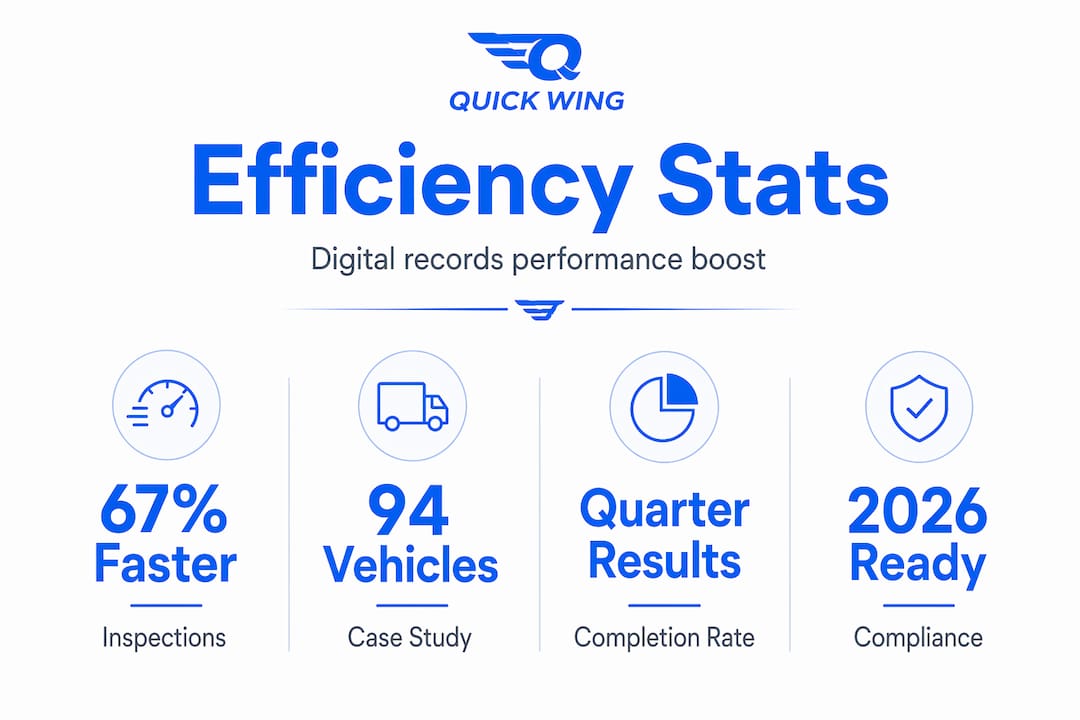
A real-world case study tracking a 94-vehicle fleet found that moving from paper to digital inspections pushed completion rates from 69% to 99.2%, cut defect response time by 93%, and saved $142,000 annually. That is not a marginal improvement. That is a transformation in how a fleet operates day to day.

A separate time-motion study confirmed the pattern. Inspection time dropped 67%, falling from an average of 18.8 minutes per inspection down to just 6.2 minutes. Errors fell by 94%. For a fleet running 100 daily inspections, that translates to $142,000 in annual labor savings alone.
Here is a direct comparison of what paper and digital systems actually look like in practice:
| Factor | Paper records | Digital records |
|---|---|---|
| Retrieval time during audit | 30 to 60 minutes | Under 2 minutes |
| Error rate | High (manual entry) | Very low (automated) |
| Inspection completion rate | Around 69% | Up to 99.2% |
| Defect response time | Slow (manual reporting) | 93% faster |
| Annual labor savings | Baseline | Up to $142,000 |
| Compliance risk | High | Significantly reduced |
The step-by-step improvements fleets experience after switching to digital fleet management typically follow a predictable pattern:
- Week one to two: Staff complete inspections on mobile devices instead of paper forms. Completion rates climb immediately because the process is faster and easier.
- Week three to four: Managers start receiving real-time alerts for flagged defects instead of waiting for end-of-day paper reports.
- Month two: Audit preparation time drops dramatically because all records are searchable and centralized.
- Month three onward: Labor costs decrease as time previously spent on manual data entry and filing is redirected to higher-value tasks.
The compounding effect is significant. Each improvement builds on the last, and within a quarter, most fleets report that the transition paid for itself.
Digital for all: Large, small, and hybrid fleets
One of the most persistent myths about digital fleet records is that they are only worth the investment for large operations. This is simply not true. Small fleets face the same compliance requirements, the same audit risks, and the same operational headaches as large ones. The difference is that small fleets often have fewer people to absorb the administrative burden, which makes efficiency gains even more valuable.
Research confirms that small fleets benefit significantly from digital records, particularly when it comes to audit retrieval. Paper is still legally accepted for small operators, but digital systems reduce retrieval time by a factor of 63 during audits. That is not a small difference. That is the difference between a smooth audit and a stressful, time-consuming ordeal.
Here is how different fleet sizes typically approach the transition:
| Fleet size | Common approach | Key benefit |
|---|---|---|
| 1 to 5 vehicles | Hybrid (digital for compliance docs, paper backup) | Low cost, high compliance gain |
| 6 to 20 vehicles | Mostly digital with some paper backup | Strong ROI, manageable transition |
| 20 or more vehicles | Fully digital | Maximum savings and compliance control |
For smaller operators, a hybrid approach is often the most practical starting point. This means going digital where it counts most, specifically for compliance-critical documents like DVIRs, driver qualifications, and maintenance logs, while keeping paper as a backup during the transition period.
Pro Tip: Do not try to digitize everything at once. Start with the documents that carry the highest compliance risk. DVIRs and driver qualification files are the two categories most likely to cause problems during an audit, so prioritize those first. Once your team is comfortable with the system, expand from there.
The key insight for small fleet operators is that the upfront investment in digital tools does not need to be large to deliver real returns. Even a simple, well-organized digital system beats a filing cabinet full of paper when an auditor walks through your door. Explore pricing options that match your fleet size so you are not paying for features you do not need.
Integration, compliance, and future trends
Digital fleet records do not operate in isolation. The real power comes when they connect with other systems your fleet already uses, particularly Electronic Logging Devices (ELDs) and maintenance scheduling tools. When these systems share data, you get a complete picture of your fleet's health and compliance status in real time.
ELDs track hours of service (HOS), while fleet logbooks track maintenance and inspections. These are not competing systems. They are complementary ones. When they are integrated, discrepancies between ELD data and maintenance records get flagged automatically, which is critical because auditors treat unexplained discrepancies as potential falsification. An integrated system catches these issues before they become violations.
The benefits of integration extend beyond compliance:
- Predictive maintenance becomes possible when mileage data from ELDs automatically triggers maintenance reminders in your fleet management system
- Driver behavior tracking connects to vehicle usage records, giving managers a fuller picture of how each vehicle is being used
- Automated reporting pulls data from multiple sources to generate compliance reports without manual effort
- Faster incident response because all relevant data, location, driver, vehicle history, and inspection records, is available in one place
The regulatory trend is also clear. With FMCSA's March 2026 authorization of electronic DVIRs, the direction of travel is firmly toward digital. Fleets that build their systems now will be ahead of the curve when further digital requirements follow, which most industry observers expect will happen within the next few years.
Pro Tip: Avoid building isolated databases. A digital system that does not talk to your other tools creates data silos, which are just a more expensive version of the same paper problem. When evaluating any fleet management platform, ask specifically how it integrates with your ELD provider and maintenance scheduler. If you want to explore what full integration looks like in practice, contact our team to walk through your specific setup.
The uncomfortable truth most guides miss about digital fleet records
Most articles about digital fleet records follow the same script. They list the benefits, show the statistics, and end with a recommendation to switch. What they rarely address is why so many fleets invest in digital tools and still do not see the results they expected.
The honest answer is that technology alone does not fix broken processes. A fleet that struggles with incomplete paper inspections will often struggle with incomplete digital inspections too, unless the underlying habits and accountability structures change alongside the tools. The software is not the solution. It is the enabler of the solution.
Some operators argue that ELDs and digital systems create their own problems, and there is a grain of truth in that perspective. When systems are poorly implemented, staff feel surveilled rather than supported, and resistance follows. But the answer is not to revert to paper, which objectively creates more errors and more compliance risk. The answer is to implement digital tools in a way that makes life easier for the people using them, not harder.
What actually works is a staged rollout focused on the biggest pain points first. Start with the documents that cause the most audit anxiety. Get your team comfortable with the new process before adding complexity. Measure the results at each stage so you can show your staff that the change is working. When people see that digital inspections take six minutes instead of nineteen, they stop resisting and start advocating.
Data silos are the second major failure point. A digital fleet management platform that does not connect to your scheduling, maintenance, and compliance tools creates a new kind of administrative burden rather than eliminating the old one. The ROI of digital records is highest when the system is genuinely integrated, not just a digital version of a filing cabinet.
The fleets that get the most out of digital records are the ones that treat the transition as a process change, not just a technology purchase. That mindset shift is the difference between modest gains and the kind of transformational results the case studies describe.
Take the next step: Smarter fleet management starts today
The evidence is clear. Digital fleet records reduce compliance risk, cut labor costs, improve inspection completion rates, and make audits far less stressful. Whether you manage five vehicles or fifty, the operational gains are real and measurable.
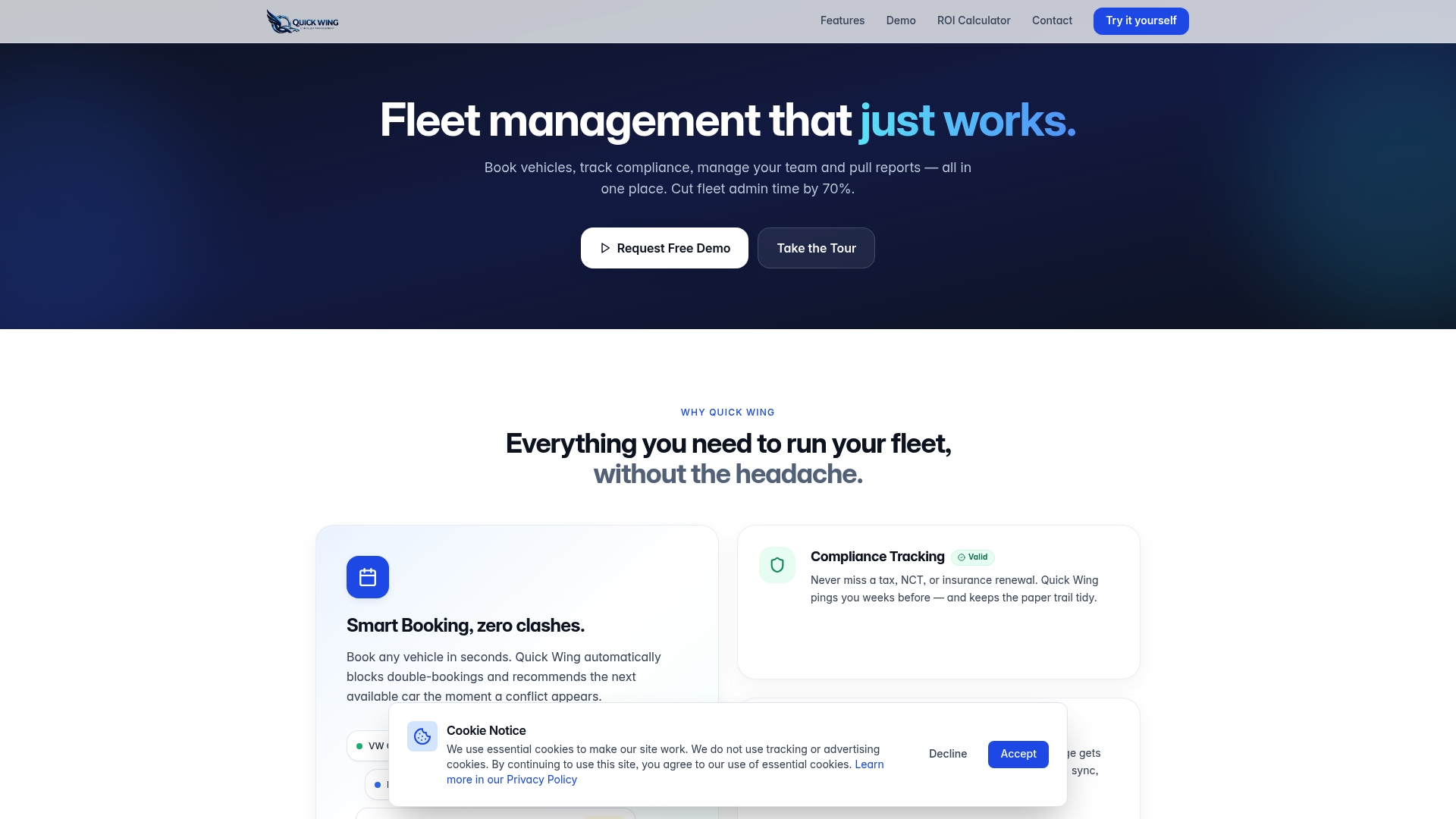
Quick Wing was built specifically for businesses that deal with vehicles every day, from home care providers coordinating shared cars to delivery teams managing driver schedules across multiple locations. It gives managers a clear view of which vehicles are booked, who is using them, when they are available, and whether compliance documents are current, all in one place without the spreadsheet chaos. Explore pricing to find the right fit for your fleet size, see all features to understand what is included, or request a demo to see how Quick Wing works with your specific operation.
Frequently asked questions
What compliance documents should be digitized first?
Prioritize DVIRs, driver qualifications, and maintenance logs, as these are the documents most commonly flagged during audits. Centralizing these records first delivers the fastest reduction in compliance risk.
Is digital recordkeeping mandatory for small fleets in 2026?
Digital recordkeeping is not yet mandatory for small fleets, but the FMCSA's authorization of electronic DVIRs effective March 23, 2026 makes it officially acceptable and strongly recommended for all operators.
What practical benefits do digital records offer daily operations?
Digital fleet records dramatically improve how your team operates every day, with inspection completion rates climbing from 69% to 99.2% and defect response times falling by 93% in documented case studies.
How do electronic DVIRs and ELDs work together?
Electronic DVIRs and ELDs are complementary systems that together provide a complete compliance picture. When they are integrated, discrepancies get flagged automatically, reducing the risk of violations being recorded during audits.